Notice!
I’ve found that this book project has been showing
up on more and more search engines lately and is also being directly linked to
for the information it contains(1). I therefore find it necessary to warn all
persons viewing this document that it is a work in progress, and as such it
contains errors of all kinds, be them in experimental procedures that may cause
harm, or in faulty reasoning that would get you slapped by nearly any chemistry
instructor. Please for now take
the information here with a grain of salt.
|
Most Importantly! By reading further you
agree not to hold the authors of this document responsible for any
injuries/fatalities that may occur from attempting to make any of the
products or following any of the procedures that are outlined within. Chemistry inherently possesses a degree of
danger and you must understand this, wear gloves and more if the situation
calls for it, your safety is in your own hands, not mine! |
Also note that this project is open for contribution
by any party on the internet. Simply
submit a section to Rob.Vincent@gmail.com
and it will be added into the text pending editing and such within a few
weeks. Any person contributing will
have their name mentioned in the credits.
Thank you for reading this, and enjoy!
|
1 |
Although
this document may be directly linked to, it will not work in that manner as I
have hotlink protection for PDF documents, however directly linking to the
html document is possible, still though I would prefer links be to the main
book project page. |
11.0 Advanced Experiments (Name Reactions)
12.0 Index (Links throughout will
be highlighted and click able to bring you to the specific index entry, e.g.
H2SO4 will be highlighted and clicking on it will bring you to a page listing
its properties, High temp oxidizing agent, dehydrating agent, different
concentrations available.)
12.1 The Elements (See Section 1.3 for a depiction of the periodic table)
Actinium Atomic Symbol: Ac Atomic
Number: 89 Atomic Weight:
227.0 g/mol Known
oxidation state(s): +3
Hazard information: Highly radioactive, most stable
isotope has a half-life of 22 years.
Aluminum Atomic Symbol: Al Atomic
Number: 13 Atomic Weight:
27.0 g/mol Known
oxidation state(s): +3
Hazard
information: The presence of aluminum cations in soft drinks is a the
suspect to some cases of Alzheimer’s.
Aluminum dust poses two hazards, it can provide an environment that
could possibly lead to an explosive mixture with the air and secondly it can
cause irritation to the respiratory system and disorientation. Always wear gloves and a dust mask when
working with aluminum in the powder form.
Bulk aluminum is safe.
Additional
information on Aluminum: Aluminum as a bulk metal is widely used in the building
industry. It is easily spotted in a
scrap yard for a few reasons, it is relatively light, and forms an oxide
coating which is easily scraped off with a knife to reveal the clean metal
underneath. Carry a small bottle of
vinegar with you if you are hunting for aluminum in a scrap yard to test samples,
scrape the surface of the aluminum clean and apply a little of the acid, it
will react with aluminum forming bubbles if it is the real deal. Aluminum turnings are also available at some
scrap yards. Aluminum powder is
available from pyrotechnic suppliers.
There are also guides online for turning bulk aluminum to powder. Aluminum powder cannot be made by the
decomposition of aluminum formate or oxylate as the finely divided aluminum can
react readily with the carbon dioxide produced to form aluminum oxide as the
majority product.
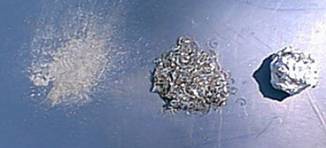
Aluminum powder,
turnings, and foil.
Industrially aluminum
is produced by the Hall process, electrolysis of aluminum oxide held in a
molten cryolite [Na3AlF6] bath. On a home scale such a process would be demanding at best. On a side interesting note one of the first
uses of sodium was as a reductant for producing aluminum from the oxide. This process has since been replaced by the
Hall process noted above.
Aluminum is a highly
reactive metal, it reacts readily with atmospheric oxygen and would simply rust
to a pile if the oxide coating thus produced did not adhere so well. If for example a small amount of mercury is
placed on a block of aluminum it continuously alloys with the aluminum
rendering the oxide coating ineffective and will allow the oxygen in the air to
rapidly oxidize large amounts of aluminum.
Aluminum will react with nearly any acid and many bases readily (it will
pacify [the surface will become coated in oxide and not react further] in
strong concentrated oxidizing acids).
Many aluminum salts are soluble and therefore are a good source of
choice anions in solution.
Americium Atomic Symbol: Am Atomic
Number: 95 Atomic Weight:
241.1 g/mol
Known oxidation state(s): +3
Hazard information: Radioactive element, treat with care.
Additional
information on Americium: Americium oxide is the source of ionization energy in the
vast majority of smoke detectors. It is
a very small piece of this radioactive element.
Antimony Atomic Symbol: Sb Atomic
Number: 51 Atomic Weight:
121.76 g/mol
Known oxidation state(s): +3, +4, +5 (least common)
Hazard
information: Excessive handling of antimony metal should be avoided as
many of the salts formed even those on contact with air could be
hazardous. Antimony and its salts have
been linked to reproductive damage and cancer.
Additional
information on Antimony: Used in alloying,
with lead in solder and in other applications, a hardening agent. Antimony is toxic and forms some interesting
salts, the pentafluoride is a component of superacids but obtaining this metal
in an over the counter way is difficult.
Antimony sulfide is used in pyrotechnics. Somewhat of a weak metal
antimony has a few interesting allotropes including the exploding antimony
allotrope which has yet to be confirmed in recent years.
Argon Atomic Symbol: Ar Atomic
Number: 18 Atomic Weight:
40.0 g/mol
Known oxidation state(s): No common oxidation states
Hazard
information: Argon is an asphyxiant gas, use with ventilation. Argon directly exiting from cylinders may be
cold enough to induce frost bite.
Additional information on Argon: (See section on inert atmospheres 8.4)
Arsenic Atomic Symbol: As Atomic
Number: 33 Atomic Weight:
74.9 g/mol Known oxidation state(s): +2, +3,
+5 (least common)
Hazard
information: Excessive handling of arsenic metal should be avoided as
many of the salts formed even those on contact with air could be
hazardous. Arsenic and its salts have
been linked to reproductive damage and cancer.
Arsenic can show progressive physical and neurological damage, the
progressive signs of arsenic poisoning are well covered. Arsenic trioxide was once known as
“Inheritance powder”.
Additional
information on Arsenic: The only widely
available compound containing arsenic is arsenic trioxide, I have seen it
marketed for the purpose of killing a variety of insects, in ant traps and less
commonly to kill mice. It’s use has
been phased out since the beginning of the 20th century
though. It is also found in some
specialty solders and in semiconductors.
From its trioxide it could be reduced with an active metal such as
magnesium to form the metal. Another
available form of arsenic comes in the form of some herbicides and pesticides
which contain arsenic organic molecules.
Arsenic is a chemically reactive metal with interesting properties
especially evident in the covalency of its high oxidation state compounds.
Astatine Atomic Symbol: At Atomic
Number: 85 Atomic Weight:
210.0 g/mol
Known oxidation state(s): NA
Hazard information: Highly radioactive, most
stable isotope has a half-life of 8 hours.
Barium Atomic Symbol: Ba Atomic
Number: 56 Atomic Weight:
137.3 g/mol Known oxidation state(s): +2
Hazard
information: Barium salts are highly toxic, a small amount of a soluble
barium salt that makes its way into your body will make you have a very bad
day, diarrhea, blood in stool, headache, stomach pains, etc. The metal itself is highly reactive towards
water along the lines of sodium and can cause minor explosions and presents a
flammability hazard on its own. The
free metal will burn the skin if it comes into contact with it. Should be stored under oil, most reactive of
the common alkali earth metals.
Additional
information on Barium: When exposed to air barium will
from an appreciable percentage of the peroxide. Very few barium salts are available to the general public, the few
that I know of are barium sulfate which is obtainable from medical clearances
(it is used to make the intestines more visible with though xray, it is one of
the very few safe barium salts), and barium ferrate, which is present in the
coating on VHS tapes. In theory a large
quantity of VHS tape could be ashed (heated till it turned to ash) then reduced
with an active metal (aluminum or magnesium) then dissolved in water, the
barium oxide thus formed would react with the water and convert to the somewhat
soluble barium hydroxide which could be extracted by evaporation and
crystallization.
Furthermore barium is available in both the hobby of pyrotechnics
(carbonate, nitrate, perchlorate, sulfate) and pottery (carbonate) for
colorization. These can be scrounged up
from local sources or from online sources.
Barium metal could be produced by aluminothermic reduction of the oxide
or carbonate or hydroxide and subsequent distillation under high vacuum. Reaction of barium oxide and aluminum metal
at high heat furnishes an alloy of high barium percentage >50% on
cooling. Barium can also be procured
though electrolysis of an eutectic mixture of barium salts in the molten state.
Berkelium Atomic Symbol: Bk Atomic
Number: 97 Atomic Weight:
249 g/mol Known oxidation state(s):
+3, +4
Hazard information: Highly radioactive, half
life sufficiently short to render amateur experimentation futile.
Beryllium Atomic Symbol: Be Atomic
Number: 4 Atomic Weight:
9.0 g/mol Known oxidation state(s): +2
Hazard information: Beryllium salts and beryllium metal dust are highly toxic
and carcinogenic.
Additional
information on Beryllium: Some aircraft
parts, specifically gyroscopes are occasionally made of almost entirely
beryllium, easily differentiated by their unearthly lightness. Machining beryllium is dangerous as shavings
and powder can cause ‘metal fume fever’ and terrible pain. Beryllium is a reactive metal that forms an
oxide coating that prevents further atmospheric attack. It is hard to find on the civilian market
though except as the aforementioned use and in a very few copper alloys. Because of the beryllium ions small size and
high charge density it forms unique cations when dissolved in water involving
several water molecules.
Bismuth Atomic Symbol: Bi Atomic
Number: 83 Atomic Weight:
209.0 g/mol
Known oxidation state(s): +3, +5 (rare)
Hazard information: Bismuth is fairly benign and safe to handle, the toxicity
of bismuth salts is almost entirely dependent upon the anion to which it is
coupled.
Additional
information on Bismuth: Bismuth is available as environmentally
friendly buck shot for re-loading guns in areas where guns are permitted, but
by this route it is fairly expensive.
Also it can be found in some areas that sell minerals and collectable
rocks, bismuth forms beautiful crystals when solidified from a properly formed
melt and are sold as a pure material, again, the price can be exhorbant. The internet is always another choice for
bismuth metal if all else fails.
Bismuth trioxide has
found use in pyrotechnics and this could be reduced with an appropriate
aluminothermic reduction. Also bismuth
subsilicate is available as an over the counter stomach soothing remedy, it may
be possible, although economically disastrous to extract this small quantity of
bismuth. Some bismuth salts, especially
those where bismuth is in the +3 state and attached to three different molecules
are prone to decomposition in water due to the formation of the stable oxy
compound. For example, a solution of
bismuth trichloride left to stand may decompose in the following manner:
BiCl3(aq)
+ H2O(l) Þ OBiCl(s) + 2HCl(aq)
Many compounds will do the
same hydrolysis reaction if left in solution too long, bismuth nitrate may form
bismuth subnitrate, bismuth chloride may precipitate as bismuth oxychloride and
there are many more. Dissolving bismuth
is a difficult chore although it comes ahead of hydrogen in the activity series
and should theoretically dissolve in acid it does so sluggishly at best, it is
necessary to add an oxidizing agent to get a decent rate of solvation of the
native metal. And as I just mentioned
it is necessary to recover your bismuth salt quickly lest it hydrolyze, the
hydroxide is a good choice as it will allow conversion to other appropriate
salts at a later date. The bismuthate
anion BiO3- in which bismuth has a +5 charge is an
excellent oxidizing agent prepared by the reaction of dry bismuth trioxide with
sodium peroxide or by the action of molten NaNO3/NaOH on bismuth
trioxide, it will oxidize manganate to permanganate.
Boron Atomic Symbol: B Atomic
Number: 5 Atomic Weight:
10.9 g/mol
Known oxidation state(s): +3
Hazard
information: Elemental boron is toxic, dust should be avoided, boron
compounds differ widely in their toxicity, for example, the chloride is a
strong irritant/corrosive liquid, whereas the acid is the only acid that is actually
good for the eyes.
Additional
information on Boron: Boron has two widely available salts, borates/metaborates
are available to some extant as borax in the cleaning industry. Borax as found in cleaning products usually
has the formula Na2B4O7*5H2O solutions
of borax can be treated with a strong acid such as HCl to precipitate out boric
acid. Boric acid can also be bought as
a somewhat pure substance from pharmacies and also from grocery stores for the
purpose of pest control. From boric
acid heat can be applied to dehydrate it to boric oxide. And from the oxide elemental boron can be
had.
Na2B4O7(aq)
+ 2HCl(aq) + 5H2O(l) Þ 2NaCl(aq) + 4B(OH)3(s)
2B(OH)3(s)
--(Heat)--> B2O3(s) + 3H2O(g)
B2O3(s) + 3Mg(s) --(Heat)--> 2B(s) + MgO(s) + x[MgB2](s)
B(s)/MgO(s)/MgB2(s) --(HCl(aq))-->
B(s) + MgCl2(aq) + B2H6(g)
In the above reactions we start from the commonly available borax with a precipitation reaction to get to our boric acid. Of if you have boric acid start from step 2. From here the acid is dehydrated and easily goes to boric oxide. The oxide is then pulverized with a hammer or other suitable object and mixed with either magnesium powder or turnings in a stoichiometric amount. The mix is ignited and a thermite reaction ensues, this generates lots of heat but the reaction must be covered loosely immediately to prevent the oxidation of the boron thus formed, at the same time a small amount of magnesium boride is formed as a side reaction. Finally after the reaction cake has cooled and is powdered, it is digested in hydrochloric acid, the magnesium oxide being a basic oxide is readily dissolved in the HCl and the magnesium boride reacts with the HCl to produce diborane. The diborane is a spontaneously flammable gas and therefore small explosions may result, it is therefore advisable to cover the cake first with water then add acid in small amounts to prevent excessive sudden gas evolution. The magnesium chloride stays in solution, the boride is decomposed and what you are left with is boron as a precipitate at the bottom of the reaction vessel.
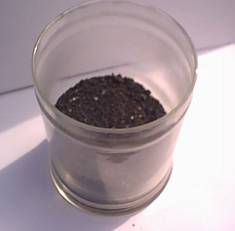
Product from aluminum reacting with B2O3, how are you going to separate that?
The first question that comes to many peoples mind when they see this thermite type reaction is weather they can substitute aluminum for the magnesium as aluminum powder is more readily made/acquired. Yes, it could be substituted in theory, but there is one drawback, see step 3 where the magnesium boride is formed as a side reaction. It could be assumed, and in this case correctly that aluminum boride [AlB12] would be formed analogously in this reaction. But the problem comes in reaction 4, aluminum boride is very inert, it will not react with the HCl and therefore you end up with very impure boron as you are unable to separate the aluminum boride (in addition the aluminum oxide is very hard to dissolve out). So what you are left with is a neigh insoluble mass of boron, aluminum oxide, and aluminum boride from which the boron is very difficult to remove. One possible removal method would be to run chlorine gas over the heated mass to produce boron trichlroide and run that over heated zinc powder to facilitate the reaction along the lines of :
B(s) + Cl2(g) Þ BCl3(g)
2BCl3(g) + 3Zn(s)
Þ
2B(s) + 3ZnCl2(s)
Although this method facilitates boron powder it makes the reaction considerably more difficult in the manipulation of chlorine gas and boron trichloride. However one could make boron trichloride directly from boric oxide and sodium chloride and run that over the zinc therefore skipping the active metal reduction with magnesium and replacing it with this zinc step.
Boron will form an additional bond at its lone pair making it a negative cation, an excellent example of this is sodium borohydride [NaBH4] in which the boron atom has a negative one charge due to the extra bond to hydrogen.
Boron is an elemental color emitter, its
combustion produces a beautiful green color and its esters produce the same.
Bromine Atomic Symbol: Br Atomic
Number: 35 Atomic Weight:
79.9 g/mol
Known oxidation state(s): -1, +3, +5, +7 (rare)
Hazard
information: Bromine is a highly corrosive red liquid. It will attack rubber, your lungs (causing
pulmonary edema), your eyes (causing blindness), and your skin (causing painful
ulcerations). Skin exposure should be
treated with a reducing agent such as sodium thiosulfate which will help to
destroy the bromine before it destroys any more of you. Although it is not highly toxic it does have
sedative effects that can result in death due to depression of the 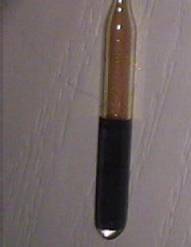 central nervous system.
Additional
information on Bromine: (See section
4.9 for further information) Bromine is a
diatomic molecule and normally appears at Br2 in formulas, in the
gaseous state it maintains these bromine-bromine bonds. Free bromine is found as the diatomic
molecule Br2 that is whenever bromine is free it is always coupled
with another bromine molecule. Your
best bet to finding commercially available bromine sources is going to be from
pool/spa suppliers. Bromination sources
include sodium bromide but more often you may find a complex organic compound
that actually acts as the brominating agent.
If possible the sodium bromide provides the much easier compound from
which to extract bromine although the organic compound could yield a
combination of bromine and bromine chloride (although this decomposes above
10C, the chlorine gas that makes its way though and comes into contact with
your condensed bromine in a receiving flask could react with the bromine
there). That is if it is sufficiently
gassed with chlorine in powder form at a temperature sufficient to distill off
the bromine [>59C].
As for bromine
production from sodium bromide. 1) Running chlorine gas though a solution of
warm sodium bromide will cause the chlorine to replace the bromine in the
compound resulting in free bromine.
This reaction really is complicated by working with chlorine gas. 2)
Reacting aqueous sodium bromide with an oxidizing agent under acidic conditions
can result in the formation of free bromine which can be distilled off:
2NaBr(aq)
+ H2SO4(l) + H2O2(aq) Þ Na2SO4(aq) + 2H2O(l)
+ Br2(l)
In the above reaction
it is the hydrogen peroxide that acts as the oxidizing agent, other oxidizing
substances; potassium permanagnate, potassium bromate; etc. could be used in
its place. Additionally different acids
could be substituted, hydrochloric acid could be substituted but there is the
possibility that it could be oxidized resulting in free chlorine contaminating
the reaction. An additional benefit to
the addition of concentrated H2SO4 is the heat of
hydration which allows the mixture to obtain a temperature to distill off the
Br2 formed without the need for significant, if any, additional
heating.
Cadmium Atomic Symbol: Cd Atomic
Number: 48 Atomic Weight:
112.4 g/mol
Known oxidation state(s): +2
Hazard
information: Highly toxic, carcinogenic, poisoning from cadmium
compounds is rare though due to their ability to induce vomiting rapidly.
Additional
information on Cadmium: Cadmium serves very few purposes in the life
of the general populous. One of the
only sources of any form of cadmium, aside from meager alloys and coatings, is
found inside of household rechargeable batteries. This is in the form of a cadmium oxide electrode. Another source of cadmium is in the form of
pigments, cadmium sulfide (yellow-brown) and selenide (red) being the main
ones. Cadmium sulfide could be
dissolved in dilute HCl and the mixture heated to reflux, hydrogen sulfide
would be evolved though which is highly toxic.
The resulting CdCl2 could be re-dissolved in neutral water
and the solution electrolyzed to yield the metal. Cadmium is resistant to alkalis but readily attacked by acids.
Calcium Atomic Symbol: Ca Atomic
Number: 20 Atomic Weight:
40.1 g/mol
Known oxidation state(s): +2
Hazard
information: Flammable as a bulk solid, spontaneously flammable in
powder/fine turnings. Calcium is non-toxic
but it can cause skin damage if handled without gloves from the basicity of the
hydrolyzed metal and the dehydrating action on the skin. Reacts readily with water forming hydrogen
gas, which can ignite and explode.
Additional
information on Calcium: Calcium is
produced most often by the electrolysis of straight molten CaCl2, in this
process the cathode must either be barely touching the surface of the melt and
slowly raised up or, constantly rotated to provide a cohesive non-porous mass
of calcium metal. The addition of up to
15% KCl can depress the melting point of the mixture without noticeable
potassium formation at the cathode but at percentages beyond this potassium
formation becomes evident. Additionally
mixing calcium chloride with chlorides of other alkali earth metals can form
eutectics which may prove useful, but despite finding patents on such mixtures,
they have found no use in industry.
During electrolysis of the molten chloride there is a very small range
over which electrolysis can progress successfully, between 780 and 800 C,
during this small frame calcium produced will be a solid and the melt will be
molten, lower then this and the melt solidifies, higher and the already highly
reactive calcium will be molten and almost guaranteed to catch fire. Remember, chlorine gas would be produced at
the anode to complicate matters even further.
Chemical reduction of
calcium oxide is another route to calcium metal production. When calcium iodide and sodium metal are
heated together in a metal vessel at high heat and the mixture allowed to cool,
calcium metal crystallizes out.
Aluminothermic reduction of calcium oxide with aluminum metal over high
heat under high vacuum has been used to isolate calcium metal, however it does
not work as well as similar reductions of other heavier alkali earths.
Calcium itself is a
great reducing agent due to the low volatility of its oxide and chloride. Heating cesium/rubidium/potassium chlorides
with calcium metal under high vacuum will distill over the free metals. Calcium carbide, a somewhat available
chemical can also act as a potent reducing agent.
Californium Atomic Symbol: Cf Atomic
Number: 94 Atomic Weight:
251.1 g/mol
Known oxidation state(s): +3, +4
Hazard information: Highly
radioactive element. However the
half-life is long enough to work with the element in macroscopic
quantities. Cf252 is the
most widely available isotope and is for sale in milligram quantities. The isotope with the longest half-life is Cf251
with a half-life of nearly 900 years.
Carbon Atomic Symbol: C Atomic
Number: 6 Atomic Weight:
12.01 g/mol
Known oxidation state(s): -4, +4 (Carbon can form hybrid orbitals
resulting in unique states)
Hazard information: Small
particles of carbon in the form of diamond can prove to be an
inhalation/ingestion hazard, in addition finely divided carbon in any of its
many forms, such as carbon black, charcoal, coal, etc. can prove detrimental to
the lungs of an individual.
Additional
Information on Carbon: It is beyond the scope of this work to
attempt to describe the entirety of organic chemistry, which would be necessary
to somewhat describe the many reactions of carbon containing compounds. Therefore focusing strictly on the
elemental, it is available in many different allotropes, the familiar diamond,
amorphous such as coal, the spheroid bucky balls (C60), nanotubes,
graphite, and a few other minor modifications.
All of these forms except bucky balls, are fairly inert to many chemical
actions except at high temperatures, at which point they become excellent
reducing agents. Finely divided carbon
can reduce many oxides to their free elemental state at high temperature. Resorting to the action of both carbon and
chlorine gas on an elemental oxide at high temperatures can be an even more
powerful reducing agent, able to reduce the inert TiO2. Reaction of
carbon at high temperatures with metals can also result in the formation of
carbides, whose reaction with water yields the metal hydroxide and acetylene
gas, with the exception of beryllium carbide and aluminum carbide, which form
true carbides and react with water to form the metal hydroxide and methane
gas. Activated charcoal and other high
surface area carbon forms are excellent catalyst for a number of operations in
chemistry, carbon is oxidized in the presence of oxygen to carbon dioxide and
in a deficient oxygen system to carbon monoxide, it can also be oxidized by
elemental sulfur at high temperature to carbon disulfide.
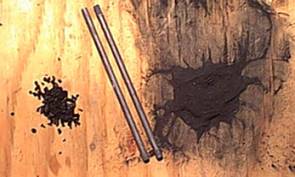
Activated Charcoal,
Graphite Rods, and Carbon Powder
Usually the preparation
of carbon is unnecessary, however amorphous carbon can be made by the reaction
between concentrated sulfuric acid and sugar.
Additionally it can be made the old-fashioned way by heating wood
without access to oxygen in a container to high temperatures and holding it
there, both forms contain impurities.
Graphite, the only common conductive from of carbon can be salvaged as
electrodes in larger batteries, diamonds find little use in chemistry. However bucky balls are starting to be more
widely produced, gram quantities are currently available. Bucky balls will actually dissolve in
organic solvents yielding brightly colored solutions depending on the exact
bucky composition used, (several different spherical structures of carbon have
now been made available).
Cerium Atomic Symbol: Ce Atomic
Number: 58 Atomic Weight:
140.1 g/mol
Known oxidation state(s): +3, +4
Hazard
information: Metal is fairly reactive, reducing water and burning
readily in the air when pure. Cerium
salts are not particularly toxic enough to warrant additional caution during
normal use.
Additional
information on Cerium: The decomposition of cerium oxalate by heat results in the
formation of cerium dioxide, which is available for polishing lenses,
especially those to do with telescopes.
Cerium compounds are also used within self cleaning ovens and cerium
itself makes up a notable percentage of mish metal, which contains many other
rare earths, mish metal is used in lighter flints and other places that need an
easy source of sparks. Cerium-iron
alloys can be prepared in such a way as to make them pyrophoric, they find use
in ignition devices. The +4 oxidation
state of cerium is not strongly oxidizing despite cerium being one of the few
lanthanides with a +4 state. Cerium
metal can be made by the electrolysis of molten cerous chloride (mp 848 °C).
Cesium Atomic Symbol: Cs Atomic
Number: 55 Atomic Weight:
132.9 g/mol
Known oxidation state(s): +1
Hazard
information: Cesium metal is incredibly reactive and can explode from
prolonged contact with the atmosphere and will explode in contact with water,
reaction with ice rapidly even below –100 °C. It is the most
reactive of the alkali metals and will easily liquefy slightly above room
temperature (28 °C). Cesium salts are moderately toxic.
Additional
information on Cesium: Cesium metal can be made by chemical methods
such as distillation from a mixture of cesium chloride and calcium metal under
a vacuum, or by electrolytic methods with the chloride, bromide, or
iodide. Supposedly cesium when viewed
in person has a slight gold color to it.
Cesium hydroxide is the most powerful of the alkali metal hydroxides, it
will readily attack glass. Sources of
cesium and its salts over the counter are rare to find. Atomic clocks use a small amount of cesium
metal and these ampoules can occasionally be purchased, in biology cesium
chloride is used to add to centrifuge tubes and create a density gradient to
separate specific components of a mixture.
In all of its sources cesium is expensive, it does not find any common
use in home chemistry.
Chlorine Atomic Symbol: Cl Atomic
Number: 17 Atomic Weight:
35.5 g/mol
Known oxidation state(s): -1, +1, +3 (rare), +4, +5, +7
Hazard
information: Chlorine gas is toxic, on inhalation it damages the lungs
and if the damage is severe enough the throat may close suffocating the
individual or the lungs may fill with fluid drowning the individual. Chlorine also attacks the eyes and
skin. Chlorides do not possess any
noticeable toxicity.
Additional
information on Chlorine (See section 4.9 for further information): Chlorine is a
diatomic gas and therefore appears in formulas as Cl2, 22.4L of
chlorine gas at STP is actually two mols of chlorine because of this
association between molecules. Chlorine forms a series of oxoacids: Hypochlorous acid (HOCl), Chlorous acid
(HOClO), Chloric acid (HOClO2), and Perchloric acid (HOClO3). Of these acids perchloric is the most stable
and chlorous acid is the most unstable although salts of it can be
isolated. Chlorine has a large area of
use in the laboratory, although alternatives to the use of free chlorine should
always be investigated due to the danger of working with it. Chlorine is a useful oxidizing agent and is
one of the simplest ways to make anhydrous metal chlorides (AlCl3, ZnCl2,
etc.). Chlorine can be made in many
ways, electrolysis of concentrated chloride solutions, electrolysis of molten
metal chlorides, acidification of hypochlorites, and other ways as well.
Chromium Atomic Symbol: Cr Atomic
Number: 24 Atomic Weight:
52.0 g/mol
Known oxidation state(s): +2, +3, +6
Hazard information: Salts of chromium in the lower oxidation states and the
free metal are not noteably hazardous, however chromium in the +6 oxidation
state, commonly dichromate, is a carcinogenic form of chromium, +6 chromium compounds
should be reacted with a reducing agent prior to disposal.
Additional
information on Chromium: Finding sources of pure chromium over the
counter is a difficult endeavor, alloys of chromium and nickel find use in
resistance heating elements and chromium metal is the main constituent (~98%)
of the chrome that covers some of the shinier parts of cars. A few chromium compounds are available over
the counter, mostly in the form of pigments and glazes for pottery. Chromate and dichromate are useful oxidizing
reagents, dichromate can be made from elemental chromium by heating the solid
chromium with potassium hydroxide and potassium nitrate while molten over high
heat, the procedure is somewhat dangerous.
Cobalt Atomic Symbol: Co Atomic
Number: 27 Atomic Weight:
58.9 g/mol
Known oxidation state(s): +2, +3
Hazard
information: Soluble cobalt compounds are toxic, the free metal is not
notably so unless ingested.
Additional
information on Cobalt: Originally found in nickel ores cobalt was
considered a nuisance to nickel production.
Cobalt compounds find limited use in home chemistry, they find use
industrially in dyes, inks, and catalysts.
The oxide CoO can be found with some searching as a pigment and
component in ceramics, this could be reduced to the element by a simple
thermite type reaction or a soluble cobalt salt can be electrolyzed, plating
out the desired cobalt on the cathode.
Copper Atomic Symbol: Cu Atomic
Number: 29 Atomic Weight:
63.5 g/mol Known oxidation state(s):
+1, +2
Hazard information: Soluble copper salts are
toxic.
Additional
information on Copper: Copper (II) salts are mild oxidizing agents
and most copper (I) salts are significantly less soluble then their comparative
copper (II) salt. Copper is widely
available, in wires, currency, electronics, etc. It can be found native in some areas of the world but for the
most part it is extracted from ore.
Copper is somewhat inert, reacting very slowly with hydrochloric or room
temperature sulfuric but readily with nitric acid. Boiling copper with sulfuric acid is one good way to produce
sulfur dioxide. Copper (II) sulfate is
avalible widely for killing tree roots that end up in sewer lines and this can
be the jumping point for making other copper salts or for electrolytic
production of copper, sufficiently heated copper sulfate will yield sulfur
trioxide which could then be solvated (with difficulty) to form sulfuric acid,
leaving behind CuO.
Curium Atomic Symbol: Cm Atomic
Number: 96 Atomic Weight:
247.1 g/mol
Known oxidation state(s): +3, +4
Hazard
information: Curium is a radioactive bone-seeking element. It is available in gram quantities but is
quite expensive and outside the price range of the average at home chemist.
Dysprosium Atomic Symbol: Dy Atomic
Number: 66 Atomic Weight:
162.5 g/mol
Known oxidation state(s): +3
Hazard information: Spontaneously flammable in
powder form, reacts slowly with water and halogens.
Additional
information on Dysprosium: Formed by the reduction of its fluoride with calcium metal,
dysprosium is a rare element with which you have little probability to run
across. It finds limited use to alter the
optic properties of mirrors and glass.
Einsteinium Atomic Symbol: Es Atomic
Number: 99 Atomic Weight:
253 g/mol
Known oxidation state(s): +2
Hazard
information: Rare and radioactive, a man-made element. Found in the green glass left over after an
atomic explosion and named after the ever-famous Albert Einstein.
Erbium Atomic Symbol: Er Atomic
Number: 68 Atomic Weight:
167.3 g/mol
Known oxidation state(s): +3
Hazard information: Flammable in powder form but
otherwise less reactive then it’s rare earth cousins, salts are toxic.
Europium Atomic Symbol: Eu Atomic
Number: 63 Atomic Weight:
152.0 g/mol
Known oxidation state(s): +2, +3
Hazard information: Highly reactive,
spontaneously flammable and reactive with water.
Additional
information on Europium: Used in the pigments on the inside of
televisions and as a neutron absorber in nuclear reactors. One of the more useful rare earths but still
quite uncommon.
Fermium Atomic Symbol: Fm Atomic
Number: 100 Atomic Weight:
254 g/mol
Known oxidation state(s): +3
Hazard information: Highly radioactive, most
stable isotope only has a half-life of 3 hours.
Fluorine Atomic Symbol: F Atomic
Number: 9 Atomic Weight:
19.0 g/mol
Known oxidation state(s): -1
Hazard information: Incredibly
reactive with nearly anything it will come across, asbestos will glow in a
stream of fluorine, water can catch on fire, and soluble fluorides are fairly
toxic, hydrofluoric acid is insanely powerful with respect to it’s ability to
decimate the human body.
Additional
information on Fluorine (See section 4.9 for further information): Fluorine is a
diatomic molecule so usually it will appear in a formula as F2,
therefore at STP 22.4 L of fluorine gas is really 2 mol of F instead of
one. Chemical production of fluorine
was only recently achieved, the first methods to produce fluorine were
electrolyitcally from a mixture of anhydrous hydrofluoric acid and potassium
fluoride. Fluorine and oxygen both have
a tendency to bring out the highest oxidation state of elements with which they
combine. If it were safer fluorine
would be the friend of the armature chemist, but this is truly a case where the
element is so dangerous as to preclude it from most any effort of use. Fluorides are interesting in that they
behave differently then most of the other halogens, for example, silver
fluoride is soluble in water, whereas the other silver halides are all
incredibly insoluble, by contrast calcium fluoride is very insoluble but the
other calcium halides show good solubility.
Solutions of fluorides are basic by the equilibrium existing:
F-(aq)
+ H2O(l) Û
HF(aq) + OH-(aq)
The equilibrium
shifting to the left due to the weakness of hydrofluoric acid. Weak solutions of hydrogen fluoride are
available over the counter for cleaning car rims, and ammonium hydrogen
fluoride finds limited use in the arts and crafts area for etching glass. Calcium fluoride is a widely available
mineral, its reaction with sulfuric acid being the basis for the production of
hydrofluoric acid.
Francium Atomic Symbol: Fr Atomic
Number: 87 Atomic Weight:
223.0 g/mol
Known oxidation state(s): +1
Hazard information: Highly radioactive, most
stable isotope only has a half-life of 3 hours. Less then 25 g on Earth at any given time.
Gadolinium Atomic Symbol: Gd Atomic
Number: 64 Atomic Weight:
157.3 g/mol Known oxidation state(s): +3
Hazard
information: Salts are toxic, free metal reacts slowly with water
forming hydrogen, do not mix gadolinium powder with oxidizing agents.
Gallium Atomic Symbol: Ga Atomic
Number: 31 Atomic Weight: 70.0 g/mol Known oxidation state(s): +2, +3
Hazard information: NA
Additional
information on Gallium: Most gallium found
online for sale and other sources is of a very high purity due to it being used
so exclusively in the semiconductor industry.
As such it can be somewhat expensive.
Gallium melts slightly above room temperature (29 °C) but is reactive so unlike mercury it will become sticky
and form a film of oxide on it, gallium metal expands as it freezes like water,
gallium has an incredibly long liquid range so it finds some limited use in
high temperature thermometers. Gallium
and its compounds find no use other then curiosity in the home lab.
Germanium Atomic Symbol: Ge Atomic
Number: 32 Atomic Weight:
72.9 g/mol
Known oxidation state(s): +2, +4
Hazard information: Germanium salts are slightly
toxic.
Additional
information on Germanium: Used almost exclusively in the electronics
industry, germanium will not react with water but dissolves readily in
acids. Germanium itself is a semi
conducting material.
Gold Atomic Symbol: Au Atomic
Number: 79 Atomic Weight:
197.0 g/mol
Known oxidation state(s): +1, +3 (auric)
Hazard Information: Gold salts are toxic but not
incredibly so.
Additional
information on Gold: Gold is relatively inert, it will not oxidize notably on
exposure to moist air and to dissolve it requires aqua regia or other somewhat
harsh techniques. Were it not for price
it would make a decent electrode in many applications. Gold has a modest melting point slightly
over 1000 °C but can be readily
fabricated due to its malleability, it can be pounded into sheets so thin that
light is visible through them. Most gold salts in solution are unstable with
respect to reduction. If for example a
solution of gold chloride is allowed to stand in sunlight the gold will
precipitate from solution as fine particles.
As for the chemical applications of gold for the at home chemist its
main role would be probably in apparatus manufacture if it were not for the
price. As such it finds little use in
the home lab aside from curioso mixture with which to deposit a layer of gold
onto glassware for aesthetic purposes.
Hafnium Atomic Symbol: Hf Atomic
Number: 72 Atomic Weight:
178.5 g/mol
Known oxidation state(s): +2, +3, +4, +6
Hazard information: Hafnium and its
compounds are all fairly toxic.
Additional
information on Hafnium: Resistant to oxidation and corrosion in general it also
finds use in electrodes and is most known for its role as a control rod
material in the nuclear industry. Of
importance relating to its role in the nuclear industry is the difficulty in
separating hafnium from zirconium (which possesses the opposite properties then
those that make hafnium desirable).
Hafnium is a dense metal with a melting point over 2000 °C, however it is fairly reactive and the free metal as a
powder can spontaneously ignite and possibly explode from exposure to the
atmosphere.
Helium Atomic Symbol: He Atomic
Number: 2 Atomic Weight:
4.0 g/mol
Known oxidation state(s): No common oxidation states
Hazard information on Helium: Helium
is an asphyxiant gas, use with adequate ventilation.
Additional
information on Helium: Up until the 1940’s helium was a very expensive commodity,
being that it is a noble gas it has no compounds from which it could be won and
due to its low molecular weight there is very little in the atmosphere. The price however dropped to less then 3% of
its previous price after it was discovered helium could be obtained in high
quantities from the gasses escaping certain oil deposits, the source, the
natural decay of radio active nuclei in the surrounding bedrock, since then different
cavernous areas and such have been tapped and the exit gasses condensed to
obtain this useful gas. Helium is quite
unreacitve although in the plasma state certain ‘compounds’ have been
identified, particularly with hydrogen.
Liquid helium also shows some very interesting properties, even when
cooled to 0 K helium remains a liquid, and it must be put under pressure to
solidify, another very interesting thing to note here is that the melting of
solid helium is exothermic. There are a
number of other incredible thermodynamic properties of helium at this state
such as the g transition, which marks its
change from a ‘superfluid’ having zero viscosity to a normal fluid. Helium being so light is nowhere near an
ideal choice for an inert atmosphere but it is discussed in section 8.4 on
inert atmospheres.
Holmium Atomic Symbol: Ho Atomic
Number: 67 Atomic Weight:
164.3 g/mol
Known oxidation state(s): +3
Hazard Information: Radioactive element,
compounds are toxic.
Additional
information on Holmium: Reacts slowly with water this metal is set apart slightly
from the other rare earth metals due to some of its magnetic and electrical
properties.
Hydrogen Atomic Symbol: H Atomic
Number: 1 Atomic Weight:
1.0 g/mol Known oxidation state(s):
-1, +1
Hazard Information: Highly flammable asphyxiant
gas.
Additional
information on Hydrogen: Hydrogen is a colorless diatomic gas so it normally appears
in equations H2, which means that at STP a mol of hydrogen ~22.4 L
is actually 2 mol of H. The normal
oxidation state of hydrogen is +1, some examples of which include HCl, CH4,
H2O, and others, hydrogen exhibits the –1 state in metallic hydrides
for the most part such as NaH and LiAlH4 (lithium aluminum hydride),
metallic hydrides are strong reducing agents and are often more reactive then
the free metals. Hydrogen is incredibly
common in the universe and is extremely easy to make either by electrolysis or
chemical methods (see section 4.13 gasses).
There are a number of uses for hydrogen in the amateur laboratory, for
the preparation of strong reducing agents (e.g., the preparation of a sodium
hydride dispersion by melting sodium under mineral oil with magnetic stirring
and bubbling hydrogen through it) or as a direct reducing agent, it can also be
a reactant for the final product such as making HBr from H2 and Br2. Some extra precautions should be taken with
hydrogen due to its high degree of flammablility and if ignition is the key
somewhere in an apparatus oxygen must be precluded from the areas you do not
want to explode otherwise the fire will flash back through the vessel.
Hydrogenation
reactions, where hydrogen adds to a molecule, usually across a double bond,
involve the reaction of hydrogen under pressure (this is a necessity) with your
molecule in the presence of a catalyst (usually transition metal such as a
platinum or palladium compound). When
dealing with these pressure reactions there is an inherent danger and hence
some of the contraptions in which they are performed are called ‘bombs’.
Indium Atomic Symbol: In Atomic
Number: 49 Atomic Weight:
114.8 g/mol
Known oxidation state(s): +1, +3
Hazard information: Indium powder and compounds
of indium are toxic.
Additional
information on indium: Indium is a shiny silvery metal, reactive enough to
dissolve in most acids, indium is used as an alloying agent in a number of
applications. It also is the ingredient
in a number of low melting alloys/eutectics.
Indium is a fairly expensive compound, and there are no commonly
available indium compounds on the market.
Iodine Atomic Symbol: I Atomic
Number: 53 Atomic Weight:
126.9 g/mol
Known oxidation state(s): -1, +1, +3, +5, +7
Hazard
information: Iodine is a skin irritant and if consumed can be fatal, the
fatal dose being about two grams, iodine anion is an essential component of the
human body.
Additional
information on iodine (See section 4.9 for further information): Like
the other halogens iodine is diatomic and as such appears in formulas as I2. Iodine is a readily sublimed solid, purplish
in appearance, its color more apparent when dissolved in non-polar solvents or
when vaporized. The reactivity of
iodine follows the trend established and as such it is less reactive then
bromine. It can be readily won from
compounds using an oxidizing agent as simple as acidic H2O2
or NaOCl, however in the latter case it can dissolve again due to the basicity
of the environment. Iodine forms a
series of oxoacids analogous to chlorine, the periodate showing evidence of
polymerization in solution.
Iridium Atomic Symbol: Ir Atomic
Number: 77 Atomic Weight:
192.2 g/mol
Known oxidation state(s): +1, +2, +3, +4, +6
Iron Atomic Symbol: Fe Atomic
Number: 26 Atomic Weight:
55.9 g/mol
Known oxidation state(s): +2, +3, +4 (rare), +5 (unstable), +6 (rare),
+7 (rare)
Krypton Atomic Symbol: Kr Atomic
Number: 36 Atomic Weight:
83.8 g/mol
Known oxidation state(s): +2 (rare)
Lanthanum Atomic Symbol: La Atomic
Number: 57 Atomic Weight:
138.9 g/mol
Known oxidation state(s): +3
Lawrencium Atomic Symbol: Lr Atomic
Number: 103 Atomic Weight:
262.1 g/mol
Known oxidation state(s): NA
Hazard information: Would be highly radioactive
as the most abundant isotope only has a half-life of 8 seconds.
Lead Atomic Symbol: Pb Atomic
Number: 82 Atomic Weight:
207.2 g/mol
Known oxidation state(s): +2, +4
Lithium Atomic Symbol: Li Atomic
Number: 3 Atomic Weight:
6.94 g/mol
Known oxidation state(s): +1
Lutetium Atomic Symbol: Lu Atomic
Number: 71 Atomic Weight:
175.0 g/mol
Known oxidation state(s): +3
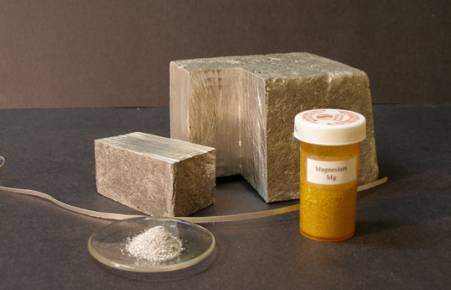
Magnesium Atomic Symbol: Mg Atomic
Number: 12 Atomic Weight:
24.3 g/mol
Known oxidation state(s): +2
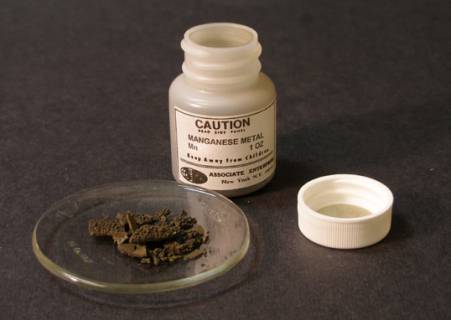
Manganese Atomic Symbol: Mn Atomic
Number: 25 Atomic Weight:
54.9 g/mol
Known oxidation state(s): +2, +3, +4, +6, +7
Mendelevium Atomic Symbol: Md Atomic
Number: 101 Atomic Weight:
258.1 g/mol
Known oxidation state(s): +2, +3
Hazard information: Longest half-life of a
mendelevium isotope is just shy of two months.
This highly radioactive element is not something you will likely run
across.
Mercury Atomic
Symbol: Hg Atomic Number:
80 Atomic Weight: 200.6 g/mol Known oxidation state(s): +1
(diatomic), +2
Molybdenum Atomic Symbol: Mo Atomic
Number: 42 Atomic Weight:
95.5 g/mol
Known oxidation state(s): +2, +3
Neodymium Atomic Symbol: Nd Atomic Number: 60 Atomic
Weight: 144.2 g/mol Known oxidation
state(s): +3
Neon Atomic Symbol: Ne Atomic
Number: 10 Atomic Weight:
20.2 g/mol
Known oxidation state(s): No Common Oxidation States
Neptunium Atomic Symbol: Np Atomic
Number: 93 Atomic Weight:
237.1 g/mol
Known oxidation state(s): +5
Nickel Atomic Symbol: Ni Atomic
Number: 28 Atomic Weight:
58.7 g/mol
Known oxidation state(s): +2, +3
Hazard
information: Many nickel salts have been shown to have carcinogenic
properties, care should be exercised with them due to these concerns.
Additional
information on nickel: Known to some as “Poor Man’s Platinum” nickel finds much
use in the amateur laboratory. In
reference to the aforementioned saying, nickel is useful for the catalysis of a
number of reactions in which platinum is traditionally used; it is an excellent
hydrogenation catalyst. In addition to
this nickel also has favorable physical properties including a high melting
point and resistance to oxidation. Also
nickel has a premium resistance to bases and good resistance to non-oxidizing
acids.
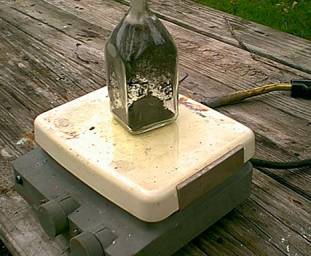 Nickel powder can be formed in a number of ways, most
notably by the reduction of a soluble nickel salt in an aqueous medium by zinc
powder or citric acid. Additionally it
can be formed as is shown at left by the decomposition of nickel oxalate formed
by the displacement reaction between sodium oxalate and a soluble nickel salt.
Nickel powder can be formed in a number of ways, most
notably by the reduction of a soluble nickel salt in an aqueous medium by zinc
powder or citric acid. Additionally it
can be formed as is shown at left by the decomposition of nickel oxalate formed
by the displacement reaction between sodium oxalate and a soluble nickel salt.
Due to the favorable
chemical resistance a number of lab items are available coated in nickel such
as the ever-present nickel spatula.
Nickel dishes and crucibles are also somewhat common. Nickel also is a major component of the
alloys used for handling the halogens including fluorine. The most common oxidation state of nickel is
+2 and in solution nickel cations usually appear green. Higher oxidations then +2 are possible, +4
has been documented and higher oxidations have been rumored.
Niobium Atomic Symbol: Nb Atomic
Number: 41 Atomic Weight:
92.9 g/mol
Known oxidation state(s): +2, +3, +4, +5
Nitrogen Atomic Symbol: N Atomic
Number: 7 Atomic Weight:
14.0 g/mol
Known oxidation state(s): -3, +5
Nobelium Atomic Symbol: No Atomic
Number: 102 Atomic Weight:
259.1 g/mol
Known oxidation state(s): NA
Hazard
information: Although nobelium has nine known isotopes, none of them
have a long enough existence to determine any of the physical or chemical
properties of this element.
Osmium Atomic Symbol: Os Atomic
Number: 76 Atomic Weight:
190.2 g/mol
Known oxidation state(s): +2, +3, +4, +6, +8
Oxygen Atomic Symbol: O Atomic
Number: 8 Atomic Weight:
16.0 g/mol
Known oxidation state(s): -2, +2 (rare)
Palladium Atomic Symbol: Pd Atomic
Number: 46 Atomic
Weight: 106.4 g/mol Known oxidation state(s): +2, +4
 Phosphorus Atomic Symbol: P Atomic
Number: 15 Atomic Weight:
31.0 g/mol
Known oxidation state(s): -3, +3, +5
Phosphorus Atomic Symbol: P Atomic
Number: 15 Atomic Weight:
31.0 g/mol
Known oxidation state(s): -3, +3, +5
Hazard
information: White phosphorus is spontaneously flammable in contact with
atmospheric oxygen and burns to form the acidic oxide P2O5, phosphorus is
soluble in many organic solvents and as such it is usually stored under
water. In addition to this white
phosphorus is highly toxic by ingestion or skin contact, areas of contact with
the skin of white phosphorus should be treated immediately with a solution of
copper sulfate and medical attention should follow. The red allotrope is fairly benign and possesses no extensive toxicological
properties, phosphates are an essential part of our daily diet. Phosphorus should never be heated with
aqueous base or the generation of phosphine may result.
Additional
information on Phosphorus: Phosphorus is one of the ancient elements in that it was
discovered well before the modern era, some time in the late 1500’s. It was originally obtained by distillation
to dryness of putrefied urine and was instantly coveted for the ability to glow
in the dark. The next step in
phosphorus production came when people realized that phosphorus was in bones,
from then bones were the raw material, first being treated with concentrated
sulfuric acid to create a solution of calcium super phosphate, which was then
filtered and heated to drive off water.
The resulting impure super phosphate was treated with coal and heated in
clay retorts to liberate phosphorus.
Later improvements utilized a mixture of silicon dioxide and coal as the
reducing mixture. In modern times the
use of bones have been replaced by phosphate rock, and the heating is now done
with resistance heating, involving temperatures in excess of 1200 °C. Lower
temperature reduction of phosphates can be facilitated however using easily
reduced phosphates such as sodium hexametaphosphate and strong reducing agents
such as aluminum or magnesium.
White phosphorus is the ‘mother’
allotrope of all phosphorus, all other allotropes convert to white phosphorus
on distillation at standard pressure.
It consists of individual P4 molecules and is very soft, easily cut with
a knife, when pure it looks like nearly clear wax. Phosphorus also has a low melting point (44 °C) and a reasonably low boiling point (280 °C). As mentioned
previously phosphorus occurs in several allotropes, a red allotrope being the
most common, it is utilized as a catalyst in the striker pad of match books, it
is a polymeric form of phosphorus and is made by dissolving phosphorus in
molten lead and keeping it at its melting point for five days or so before
removing from the lead in any of a number of ways including electrolysis of the
resulting lead. Red phosphorus can also
be prepared from white phosphrous simply by the action of light on white
phosphorus, as shown in the picture above.
It also occurs as a black allotrope which is the most stable, this is
formed with difficulty under several hundred times atmospheric pressure and
with heating, and occasionally in the presence of a mercury catalyst. Both allotropes sublime under heating and
condense as the white allotrope.
Phosphorus finds use in organic synthesis
mostly in the form of its inorganic compounds such as PCl3, PCl5, POCl3, and
PBr3. The halides being easily formed
by direct reaction of phosphorus with the halogen in question. These compounds are fuming highly reactive
chemicals, reacting with water to form phosphoric acid and the hydrogen halide
for the most part. In the United States
phosphorus is a controlled substance and it is illegal for an individual to own
in nearly any quantity. This is due
mainly to its use in the production of substances of abuse and to a much lesser
extent the possibility of producing precursors to nerve gasses.
Platinum Atomic Symbol: Pt Atomic
Number: 78 Atomic Weight:
195.1 g/mol
Known oxidation state(s): +2, +4
Plutonium Atomic Symbol: Pu Atomic
Number: 94 Atomic Weight:
239.1 g/mol
Known oxidation state(s): +3, +4, +5, +6
Polonium Atomic Symbol: Po Atomic
Number: 84 Atomic Weight:
210.0 g/mol
Known oxidation state(s): +2, +4
Potassium Atomic Symbol: K Atomic
Number: 19 Atomic Weight:
39.1 g/mol
Known oxidation state(s): +1
Praseodymium Atomic Symbol: Pr Atomic
Number: 59 Atomic Weight:
141.0 g/mol Known oxidation state(s): +3
Promethium Atomic Symbol: Pm Atomic
Number: 61 Atomic Weight:
146.9 g/mol
Known oxidation state(s): +3
Protactinium Atomic Symbol: Pa Atomic
Number: 91 Atomic Weight:
231.0 g/mol
Known oxidation state(s): +5
Radium Atomic Symbol: Ra Atomic
Number: 88 Atomic Weight:
226.0 g/mol
Known oxidation state(s): +2
Radon Atomic Symbol: Rn Atomic
Number: 86 Atomic Weight:
222.2 g/mol
Common oxidation statse: +2, +4, +6 (rare)
Rhenium Atomic Symbol: Re Atomic
Number: 75 Atomic Weight:
186.2 g/mol
Known oxidation state(s): +1, +2, +3, +4 (stable), +5, +6 (stable), +7
(stable)
Rhodium Atomic Symbol: Rh Atomic
Number: 45 Atomic Weight:
102.9 g/mol
Known oxidation state(s): +3
Rubidium Atomic Symbol: Rb Atomic
Number: 37 Atomic Weight:
85.5 g/mol
Known oxidation state(s): +1
Ruthenium Atomic Symbol: Ru Atomic
Number: 44 Atomic Weight:
101.1 g/mol
Known oxidation state(s): +3, +4, +5, +6, +8
Samarium Atomic Symbol: Sm Atomic
Number: 62 Atomic Weight:
150.4 g/mol
Known oxidation state(s): +3
Scandium Atomic Symbol: Sc Atomic
Number: 21 Atomic Weight:
45.0 g/mol
Known oxidation state(s): +3
Selenium Atomic Symbol: Se Atomic
Number: 34 Atomic Weight:
79.0 g/mol
Known oxidation state(s): -2, +2, +4, +6
Silicon Atomic Symbol: Si Atomic
Number: 14 Atomic Weight:
28.1 g/mol
Known oxidation state(s): -4,
+4
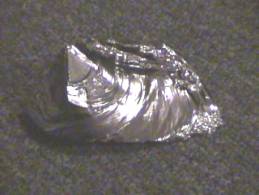
Silver Atomic Symbol: Ag Atomic
Number: 47 Atomic Weight:
107.9 g/mol
Known oxidation state(s): +1, +2 (rare)
Sodium Atomic Symbol: Na Atomic
Number: 11 Atomic Weight:
23.0 g/mol
Known oxidation state(s): +1
Strontium Atomic Symbol: Sr Atomic
Number: 38 Atomic Weight:
87.6 g/mol
Known oxidation state(s): +2
Sulfur Atomic Symbol: S Atomic
Number: 16 Atomic Weight:
32.1 g/mol
Known oxidation state(s): -2, +2, +4, +6
Tantalum Atomic Symbol: Ta Atomic
Number: 73 Atomic Weight:
181.0 g/mol
Known oxidation state(s): +2, +3, +5
Technetium Atomic Symbol: Tc Atomic
Number: 43 Atomic Weight:
99.0 g/mol
Known oxidation state(s): +4, +5, +6, +7
Tellurium Atomic Symbol: Te Atomic
Number: 52 Atomic Weight:
127.6 g/mol
Known oxidation state(s): -2, +2, +4, +6
Terbium Atomic Symbol: Tb Atomic
Number: 65 Atomic Weight:
158.9 g/mol
Known oxidation state(s): +3, +4
Thallium Atomic Symbol: Tl Atomic
Number: 81 Atomic Weight:
204.4 g/mol Known oxidation state(s):
+1, +3
Thorium Atomic Symbol: Th Atomic
Number: 90 Atomic Weight:
232.0 g/mol
Known oxidation state(s): +4
Thulium Atomic Symbol: Tm Atomic
Number: 69 Atomic Weight:
168.9 g/mol
Known oxidation state(s): +3
Tin Atomic
Symbol: Sn Atomic Number:
50 Atomic
Weight: 118.7 g/mol Known oxidation
state(s): +2, +4
Titanium Atomic Symbol: Ti Atomic
Number: 22 Atomic Weight:
47.9 g/mol
Known oxidation state(s): +3, +4
Tungsten Atomic Symbol: W Atomic
Number: 74 Atomic Weight:
183.9 g/mol
Known oxidation state(s): +2, +4, +5, +6
Uranium Atomic Symbol: U Atomic
Number: 92 Atomic Weight:
238.0 g/mol
Known oxidation state(s): +3, +4, +6
Vanadium Atomic Symbol: V Atomic
Number: 23 Atomic Weight:
50.9 g/mol
Known oxidation state(s): +2, +3, +4, +5
Xenon Atomic Symbol: Xe Atomic
Number: 54 Atomic Weight:
131.3 g/mol
Known oxidation state(s): +2, +4, +6, +8
Ytterbium Atomic Symbol: Yb Atomic
Number: 70 Atomic Weight:
173.0 g/mol
Known oxidation state(s):
+2, +3
Yttrium Atomic Symbol: Y Atomic
Number: 39 Atomic Weight:
88.9 g/mol
Known oxidation state(s): +3
Zinc Atomic Symbol: Zn Atomic
Number: 30 Atomic Weight:
65.4 g/mol Known oxidation state(s): +2
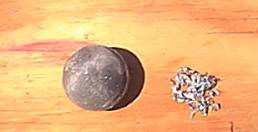
A ball of Zinc and
turnings produced from it.
Zirconium Atomic Symbol: Zr Atomic
Number: 40 Atomic Weight:
91.2 g/mol
Known oxidation state(s): +2, +3, +4
Compounds
Technical
Terms
Decantation
A method of separation based upon insolubility of a
substance in a particular solvent (for instance Fe2O3 in water). The insoluble
substance is left to sink to the lower portion of the solvent where after the
upper portion of the solvent is poured off.
Destructive Distillation
A process of distillation wherein an organic material
(such as wood) is strongly heated in the absence of oxygen. It will decompose
into several useful substances which are separated from each other by the
distillation process. (E.g. Wood will decompose into volatile gases and
charcoal.) This method of distillation differs from “normal” distillation as it
is meant to obtain several substances from a single source. Rather than
distilling a mix of those substances a single compound is thermolysed to yield
several new substances. The original substance is destroyed in the process.
Hence; “destructive” distillation.
Suction Filtration
When filtration is not proceeding quick enough it may
be sped up by applying a vacuum. The liquid is then "sucked" through
the filter (technically it is pushed through the filter by the positive
pressure on top of the liquid). Suction filtration is particularly useful when
a suspension is being filtered as suspensions tend to hold liquids rather well.
Precipitate
When an insoluble chemical is created in a reaction it
will form a very fine powder in suspension. This powder is referred to as a
precipitate. Depending on the speed of the precipitation the size of the grains
of the powder may vary from extremely small to very large. Artificial diamonds
are precipitated carbon crystals; they are precipitated from saturated
solutions of carbon in liquid iron. By keeping the speed of precipitation low a
single crystal can be grown.
Supernatant
When analysing a system that contains a
liquid which is not the desired product and a desired precipitate which has
sunk to the bottom, the supernatant is the liquid above the precipitate, the
supernatant is usually removed by careful decantation from the solid
precipitate until the precipitate remains at the bottom with only a small
amount of supernatant which can then be allowed to carefully evaporate or the
precipitate can then be filtered.
Cation
Ions with a positive charge (e.g. Fe2+, Cu2+
Al3+ etc.)
Anion
Ions with a negative charge (e.g. halides such as Cl-,
Br- and I- but also P3-, O2- etc.)
Pyrophoric
Substances that spontaneously ignite in air are called
"pyrophoric". (E.g. K(s), Na(s), extremely fine metal powders are also
pyrophoric. So are boranes, phosphines, silanes and certain metallo-organic
chemicals.)
Flash Point
The lowest temperature at which a substance can form
an ignitable mixture in air. The lower the flash point the easier a substance
can ignite in air.
Explosive Limit
Every substance has 2 explosive limits, an upper- and
a lower-explosive limit. When the saturation of the substance has not yet
reached the lower-explosive limit it cannot ignite because of a lack of fuel.
When the saturation level of the substance in air is exceeded it will not be
able to ignite either because there is too much fuel (and thus too little
oxygen) for successful (self propagating) combustion. Some substances can have narrow explosive limits such as ammonia
16-25% by volume or very large ranges of explosive concentrations such as
hydrazine 3-99% by volume.
Supersaturated
When a solution is "supersaturated" it
contains more of a certain chemical in solution than it should be able to
contain. Supersaturated solutions are stable as long as they are left
undisturbed. As soon as an uneven surface, sufficient motion, or additional
components are introduced the excess dissolved chemical will come out of
solution in crystalline form.
Supercooled
Some liquids can be cooled below their freezing point
without solidifying. They are stable as long as they are left undisturbed. As
soon as an uneven surface or sufficient motion is introduced the liquid will
solidify.
Anode
A positive electrode (usually the red wire), this is
where oxidation occurs in electrolysis.
Fe2+(aq) Þ Fe3+(aq)
Cathode
A negative electrode (usually the black wire), this is
where reduction occurs in electrolysis.
Cu2+(aq) Þ Cu(s)
Filtrate
The liquid that is left after a filtration. (E.g.
Coffee after hot water is poured upon the ground coffee beans in the filter)
Scrub (gas)
When a gas consists of multiple mixed gases one or
more of those gasses may be removed by scrubbing the gaseous mixture. This may
be accomplished by leading the gas through a reagent (-solution) that will
react with only some of the constituents of the mix. (E.g. leading air
containing H2S through a NaOH or KOH solution will remove the H2S gas from the
air.) Scrubbers are often used to remove potentially harmful gasses from
effluent gases. They are also used to remove gases from air before the air is
lead into a reaction chamber if these gases might unduly influence the desired
reaction. (E.g. water is removed from air before it is lead into a chamber
where it will be used to react with SO2 to form SO3 to
prevent premature formation of sulphuric acid.)
Wash (precipitate)
A precipitate can be “washed” by adding
the solvent that it will not dissolve in and decanting or filtering it. Every
time the precipitate is “washed” it will become more pure as the pollutions it
contained are dissolved and flushed away.
Superheating
Superheating occurs when a liquid is heated past its
boiling point without actually boiling. This can happen by rapidly heating a
homogenous liquid in the absence of nucleation sites where bubbles may form. (A
nice example is boiling water in a clean glass in a microwave. It will appear
as if not boiling (no bubbles are formed) but as soon as a teabag is introduced
explosive boiling may occur [see Flash Boiling].)
Flash Boiling
An explosive form of boiling where all of a liquid
boils instantaneously. (Rather than nucleated boiling as would normally occur
where bubbles are formed) May occur when a superheated liquid is suddenly violently
shaken or subjected to a huge amount of boiling-nuclei such as a spoonful of
sugar of finely ground tea in the case of micro waved tea water. Flash boiling can also occur if a new clean
beaker or test tube is heated containing a liquid un disturbed, the liquid can
then attain a temperature above its boiling point [see Superheating] and upon
any outside mechanical action can flash boil which may result in hot liquid
going everywhere, the addition of boiling stones, or pieces of glass, or
mechanical stirring from the start can avoid this problem.
Catalyst
A substance that accelerates a reaction (by lowering
the activation energy of that reaction) without being used up that does not
influence the equilibrium of that reaction. An example being manganese dioxide
and hydrogen peroxide mixing together and resulting in the decomposition of the
peroxide to oxygen and water.
Stoichiometry
Stoichiometry is a quantitative approach to
chemistry. In a stoichiometric
calculation the mols of one substance is equated to another factor, for example
the mols of another substance or to the volume of a pure liquid required to
give a certain concentration. If a
reaction is referred to as a ‘stoichiometric’ reaction it usually insinuates
that equimolar ratios are used, i.e., the exact amounts of reactants are used
as predicted by theory in a reaction and it is usually assumed the reaction
goes to completion. Here is an example
stoichiometric calculation:
|
AgNO3(aq) + HCl(aq) Þ HNO3(aq) + AgCl(s) Above is the reaction that we wish to follow, let’s
assume we have 100 ml of a 1.70 M HCl solution and we want to convert it all
to HNO3, how much AgNO3 do we need to make the reaction stoichiometric? 0.1 Notice that the liters cancel in the above reaction,
hence the strike through, they cancel because on is in the numerator and the
other in the denominator, they divide away.
Now that we have the number of mols of HCl that are in solution we can
carry out the more difficult stoichiometric calculation.
This is how a majority of American texts will teach
stoichiometry. Starting from the left
we see the 0.17 mol of HCl we had calculated before, now we need the number
of grams that will give us the same number of mols of silver nitrate. So, the next step is the conversion, one
mole of hydrochloric acid requires one mole of silver nitrate. So you divide by 1 mol HCl to cancel HCl
and that equates to one mol AgNO3 which appears in the numerator. Now, one mole of AgNO3 is equal to 168.87
grams, so divide by 1 mol AgNO3 to cancel it because we want our answer in
grams and multiply by the number of grams per mol. So in the above equation everything cancels but the grams,
which is the answer you want, in this case it is 28.88 grams that are
necessary. Note that there are easier
less elaborate systems to get the same number but they are all considered
stoichiometric. |

Allotrope
A particular form of an element. (E.g. Phosphorous can
exist as white and red phosphorous; oxygen can exist as O2 and O3; carbon can
exist as graphite, diamond, fullerenes, nanotubes and many more forms.)
Specific allotropes of elements may be denoted by stating the element and its
allotropic form as follows "Element (allotropic form)". E.g. Diamond
may be denoted as C(diamond) and graphite may be denoted as C(graphite).
Phosphorous is often denoted as either P(red) or P(white).
Phase (liquid)
In this test the term phase is used to discern between
two immiscible liquids. In most cases there
is an aqueous phase and an organic phase.
Usually the aqueous phase is the bottom phase, and the organic is the
top, the determination of which is top and which is bottom made by the density
of the two liquids. However there are
organics more dense then water, chloroform being a good example (d. 1.5 g/ml)
which would form the bottom phase in a strictly water/chloroform mixture. Three phase mixtures can exist but are
unstable and can mix together with agitation.
Two phase mixtures can often be forced to mix together using strong
shaking, at least for short periods of time forming emulsions which can
separate back into their two components, although some emulsions are
stable. The concept of these different
liquid phases comes into use when washing a liquid compound or solution and
keeping track of which is your product and which is your waste phase. A good way to differentiate is to simply add
a drop of water to your phases and see which phase it ends up in if you are
having trouble discerning organic form aqueous phases.
Azeotrope
An azeotrope is a liquid mixture of two or more
components which has a unique constant boiling point. This azeotrope may boil
at a higher, lower, or intermediate temperature, relative to the constituent
liquids, and the liquid retains the same composition as it is boiled. As a
consequence, the vapour has the same composition as the liquid and simple
distillation will not separate the constituents as it would with most liquid
mixtures.
The word azeotrope comes from the Greek "zein
tropos", or "constant boiling". An azeotrope is said to be
positive if the constant boiling point is at a temperature maximum, and
negative when the boiling point is at a temperature minimum. The vast majority
of azeotropes are minimum boiling. All liquid mixtures which are immiscible and
which form azeotropes are minimum boiling.
Examples of azeotropes:
* Nitric
acid (68.4%) / water, boils at 122°C
*
Perchloric acid (28.4%) / water, boils at 203°C (negative azeotrope)
*
Hydrofluoric acid (35.6%) / water, boils at 111.35°C (negative azeotrope)
* Ethanol
(95%) / water, boils at
* Sulphuric
acid (98.3%) /water, boils at 330°C
* Acetone /
methanol / chloroform form an intermediate boiling azeotrope
(Source: http://en.wikipedia.org/wiki/Azeotrope)
Electrolyte
A substance that may dissociate into ions when
dissolved in a solvent. Salts, acids and bases are all by definition
electrolytes. In aqueous solutions
electrolytes allow for the conduction of electric current.
Eutectic
A eutectic is a mixture of 2 or more elements that has
a lower melting point than any of its constituents and usually the lowest
melting point between the two substances possible. (E.g. A solution of NaCl in
water will freeze at -21.2 °C which is a lower melting point than that of any
of its constituents.) An eutectic
mixture can be thought of loosely as somewhat of an azeotrope of freezing. If for example a solution has more of
component A then B to form the lowest melting eutectic, the component A will crystallize
out or otherwise separate first and then the solution further cooled until the
eutectic mixture crystallizes out.
Other notable eutectics include the eutectic formed between potassium
(78% by wt.) and sodium (22% by wt) metals (fp –12.6 °C) and the common eutectics taken advantage of in
over the counter solders.
Polar (liquid)
A liquid that consists of polar molecules. A molecule
is polar when the electron density is unevenly spread across the molecule. For
instance water is a polar liquid because the O is more negatively charged than
the 2H's (which are relatively positively charged). Polar liquids may dissolve
(some) salts into their constituent ions and are referred to as hydrophilic
(water loving) liquids. Because they will mix with water. Generally speaking
polar substances will dissolve into polar solvents and not into non-polar
solvents.
Non-Polar (liquid)
A non-polar liquid is a liquid that is made up of nonpolar
molecules. Non-polar liquids generally have lower boiling points than polar
liquids because they are not held together by molecular bonds as tightly as
polar molecules. (Think of a polar liquid as many many tiny magnets flowing
through each other. They attract each other. A non-polar liquid would be like a
lot a tiny tiny plastic bars flowing through each other. They do not attract
each other very much at all). They referred to as hydrophobic (water fearing)
liquids because they will not mix with polar liquids very well at all. They
will not dissociate salts into their constituent ions. Generally speaking
non-polar substances will dissolve into non-polar solvents and not into polar
solvents.
Supercritical water
At STD water will boil at 100°C (or 212°F or
373,16K) but when the pressure is raised its boiling point will rise with it.
The pressure can be raised until a certain pressure is reached at which the
water will no longer boil at all. In stead it will reach a next “phase”, the
so-called “supercritical” phase. This is not really a phase as it is more of a
hybrid between a gaseous and a liquid state. It is considered such because it
has properties of both these phases. It has excellent solvent properties like a
liquid (supercritical water can dissolve pure gold!) but also possesses
excellent diffusability (It can quickly fill up any hole) like a gas. It also
has some unique capabilities of its own. Its volume can vary to a great extent
in a continuous manner when the pressure and temperature are varied. Water
becomes supercritical at a pressure of 22,1MPa and a temperature of 374°C.
Carbon dioxide (CO2) can also become supercritical but at 7,38MPa
and 31.1°C. All liquids can become supercritical at the right pressure and
temperature. Supercritical liquids/gases are used in the industry as
high-efficiency solvents. E.g. Supercritical CO2 is used to extract
caffeine from coffee beans to make de-caf coffee (the leftover caffeine is used
for medicinal applications).
13.0
Appendix (Specific Procedures/Additional
Experiments)
13.1 Salts (Nearly)Insoluble in
cold neutral water:
|
Calcium Oxylate (AS) |
Ca(COO)2 |
6.7 x 10⁻⁴ g/100ml |
|
Calcium Sulfate |
CaSO4 or CaSO4
* 2H2O |
.241 g/100ml |
|
Barium Sulfate |
BaSO4 |
2.22 x 10⁻⁴ g/100ml |
|
Silver Chloride |
AgCl |
8.9 x 10⁻⁵ g/100ml |
|
Silver Bromide |
AgBr |
8.4 x 10⁻⁶ g/100ml |
|
Silver Iodide |
AgI |
3 x 10⁻⁷ g/100ml |
|
Magnesium Hydroxide (AS) |
Mg(OH)2 |
9.0 x 10⁻⁴ g/100ml |
|
Aluminum Fluoride |
AlF3 or AlF3*3H2O |
---- |
|
Barium Carbonate (AS) |
BaCO3 |
2.0 x 10⁻³ g/100ml |
|
Barium Chromate (AS) |
BaCrO4 |
3.4 x 10⁻⁴ g/100ml |
|
Barium Citrate |
Ba3 (C6H5O7)2
*7H2O |
4.06 x 10⁻² g/100ml |
|
Barium Oxylate (AS) |
Ba(COO)2 |
9.3 x 10⁻³ g/100ml |
|
Barium Phosphate (AS) |
Ba3(PO4)2 |
------ |
|
Barium Sulfite |
BaSO3 |
2.0 x 10⁻² g/100ml |
|
Bismuth Hydroxide (AS) |
Bi(OH)3 |
1.4 x 10⁻⁴ g/100ml |
|
Cadmium Carbonate (AS) |
CdCO3 |
----- |
|
Camium Hydroxide (AS) |
Cd(OH)2 |
2.6 x 10⁻⁴ g/100ml |
|
Cadmium Oxalate (AS) |
Cd(COO)2 |
3.3 x 10⁻³ g/100ml |
|
Calcium Carbonate (AS) |
CaCO3 |
1.45 x 10⁻³ g/100ml |
|
Calcium Fluoride |
CaF2 |
1.6 x 10⁻³ g/100ml |
|
Calcium Hydroxide (AS) |
Ca(OH)2 |
1.8 x 10⁻¹ g/100ml |
|
Calcium Phosphate (AS) |
Ca3(PO4)2 |
2.5 x 10⁻³ g/100ml |
|
Calcium Metasilicate (AS) |
CaSiO3 |
9.5 x 10⁻³ g/100ml |
|
Cesium Aluminum Sulfate |
CsAl(SO4)2 *
12H2O |
3.4 x 10⁻¹ g/100ml |
|
Cobalt (II) Carbonate (AS) |
CoCO3 |
----- |
|
Cobalt (II) Chromate (AS) (OxA) |
CoCrO4 |
----- |
|
Cobalt (II) and (III) hydroxide (AS) |
Co(OH)2 & Co(OH)3 |
----- |
|
Copper (I) & (II) Carbonate (AS) (Am) |
Cu2CO3 &
CuCO3 |
----- |
|
Copper (I) Halides (AS) (Am) |
CuX |
----- |
|
Copper (I) & (II) Hydroxide (Am) |
CuOH & Cu(OH)2 |
----- |
|
Lead Phosphate (AS) (BS) (OxA) |
Pb3(PO4)2 |
1.4 x 10⁻⁵ g/100ml |
|
Mercury (I) Chloride |
Hg2Cl2 |
2.1 x 10⁻⁴ g/100ml |
|
Lead (II) Chloride |
PbCl2 |
6.73 x 10⁻¹ g/100ml |
|
Mercury (II) Sulfide |
HgS |
1.0 x 10⁻⁶ g/100ml |
|
Lead (II) Sulfide (OxA) (AS) |
PbS |
1.2 x 10⁻² g/100ml |
|
Copper (I) Sulfide (OxA) (Am) |
Cu2S |
|
|
Copper (II) Sulfide (OxA) (Am) |
CuS |
3.3 x 10⁻⁵ g/100ml |
|
Cadmium (II) Sulfide (OxA) |
CdS |
----- |
|
Arsenic Sulfide (OxA) |
As2S3 |
----- |
|
Antimony Sulfide (OxA) |
Sb2S3 |
----- |
|
Tin (IV) Sulfide (OxA) |
SnS2 |
----- |
|
Aluminum Hydroxide (AS) (BS) |
Al(OH)3 |
----- |
|
Iron (II) Sulfide (OxA) |
FeS |
----- |
|
Manganese (II) Sulfide |
MnS |
----- |
|
Zinc Sulfide (OxA) |
ZnS |
----- |
|
Nickel (II) Sulfide (OxA) |
NiS |
----- |
|
Cobalt (II) Sulfide (OxA) |
CoS |
----- |
|
Strontium Phosphate |
Sr3(PO4)2 |
----- |
|
Zinc Hydroxide (AS) (BS) |
Zn(OH)2 |
----- |
|
Chromium (III) Hydroxide (AS) (BS) |
Cr(OH)3 |
----- |
|
Iron (III) Hydroxide |
Fe(OH)3 |
----- |
|
Copper (II) Oxylate (Am) |
Cu(COO)2 |
2.5 x 10⁻³ g/100ml |
|
Bismuth (III) Sulfide (OxA) |
Bi2S3 |
----- |
|
Gold Sulfide (OxA) |
Au2S |
----- |
|
Iron Ferricyanide |
Fe3 [Fe(CN)6]2 |
----- |
|
Lead (II) Bromide (AS) |
PbBr2 |
4.5 x 10⁻¹ g/100ml |
|
Lead (II) Chromate (BS) (AS) |
PbCrO4 |
5.8 x 10⁻⁶ g/100 ml |
|
Lead (II) Carbonate (BS) (AS) |
PbCO3 |
1.1 x 10⁻⁴ g/100ml |
|
Lead (II) Hydroxide (BS) (AS) |
Pb(OH)2 |
1.5 x 10⁻² g/100ml |
|
Lead (IV) Oxide (AS) |
PbO2 |
----- |
|
Lead (II) Oxylate |
Pb(COO)2 |
1.6 x 10⁻⁴ g/100ml |
|
Lead (II) Sulfate |
PbSO4 |
4.25 x 10⁻³ g/100ml |
|
Magnesium Carbonate (AS) |
MgCO3 |
----- |
|
Magnesium Fluoride (OxA) |
MgF2 |
7.6 x 10⁻³ g/100ml |
|
Magnesium Oxylate (BS) (AS) |
Mg(COO)2 |
7.0 x 10⁻² g/100ml |
|
Magnesium Phosphate (AS) |
Mg3(PO4)2 |
2.0 x 10⁻² g/100ml |
|
Manganese (II) Fluoride (AS) |
MnF2 |
----- |
|
Manganese (II) Hydroxide (AS) |
Mn(OH)2 |
2.0 x 10⁻³ g/100ml |
|
Manganese (II) Oxylate (AS) |
Mn(COO)2 |
----- |
|
Mercury (I) (AS) and (II) Bromide |
Hg2Br2 &
HgBr2 |
------ |
|
Mercury (I) and (II) Carbonate (AS) |
Hg2CO3 &
HgCO3 |
----- |
|
Mercury (II) Phosphate (AS) |
Hg3(PO4)2 |
------ |
|
Molybdenum (II) and (III) Bromide |
MoBr2 & MoBr3 |
----- |
|
Molybdenum (II) and (III) Chloride |
MoCl2 & MoCl3 |
----- |
|
Molybdenum Sulfides |
Mo2S3 and
MoS2 |
----- |
|
Nickel (II) Carbonate (AS) |
NiCO3 |
9.3 x 10⁻³ g/100ml |
|
Nickel (II) Fluoride |
NiF2 |
2.0 x 10⁻² g/100ml |
|
Nickel (II) Hydroxide (AS) (Am) |
Ni(OH)2 |
1.3 x 10⁻³ g/100ml |
|
Nickel (II) Oxylate (AS) |
Ni(COO)2 |
----- |
|
Nickel (II) Phosphate (AS) |
Ni3(PO4)2 |
----- |
|
Potassium Perchlorate |
KClO4 |
7.5 x 10⁻¹ |
|
Silver Carbonate (Am) |
Ag2CO3 |
3.2 x 10⁻³ g/100ml |
|
Silver Oxide (AS) |
Ag2O |
1.3 x 10⁻³ g/100ml |
|
Silver Phosphate (Am) (AS) |
Ag3PO4 |
6.5 x 10⁻⁴ g/100ml |
|
Silver Sulfate (Am) (AS) |
Ag2SO4 |
5.7 x 10⁻¹ g/100ml |
|
Tin Phosphate |
Sn3(PO4)2 |
----- |
|
Zinc Carbonate (AS) (BS) |
ZnCO3 |
1.0 x 10⁻³ g/100ml |
|
Zinc Cyanide (BS) |
Zn(CN)2 |
5.0 x 10⁻⁴ g/100ml |
(AS) = Increased solubility in acids (BS) = Increased solubility in bases (OxA) = Soluble in oxidizing acidic conditions (Am) = Can be rendered soluble in the presence of ammonia
13.2 A study of various additives on kaolin based
ceramics by Cyrus:
Hypotheses:
The rate of shrinkage upon firing decreases linearly as the percentage of kaolin decreases. The green strength (unfired
strength) and fired strength of the rods decreases linearly as the percentage of kaolin decreased. The strongest and most suitable formulation for crucibles is composed of clay and graphite.0
Experimental
Procedure:
- Powder Mixing:
~Various ceramic powders were weighed out using an Ohaus dial-o-gram scale and placed in a cup. (for example 6.00 g kaolin, 4.00 g silica; 10.00 grams total material was used for most formulations)
~The contents were stirred for several minutes, placed in another cup, combined with enough water to make the mixture very plastic but not enough to make the mixture fluid, and then mixed using a painter’s spatula for several more minutes.
- Extrusion
~Using the spatula, the ceramic mixture was placed inside of a syringe with a 0.476 cm inside diameter extrusion orifice.
~The slurry was then extruded onto paper towels by gently pressing down on the syringe piston as the syringe was slowly drawn back toward the body at a low angle relative to the paper towel. The bead diameter was kept as close to 0.476 cm as possible.
~The ceramic rods (approximately 5 per formula) were dried and organized.
- Pre-firing measurements
~The lengths of 2 rods of each formula were measured in centimeters using a standard ruler accurate to the nearest millimeter, and estimating to the nearest tenth of a millimeter.
~Several rods of each formula were placed on the 3 point flexural strength apparatus and the pressure on the rods was increased gradually until the rod cracked. The force required to crack each rod was recorded.
- Firing
~Each ceramic rod was labeled using a glaze composed of black iron oxide, talc, and kaolin, placed in slip cast kaolin/alumina crucibles, and preheated in the oven to 550 deg. F. This drives off any water remaining, preventing the rods from exploding from steam.
~The crucibles were then placed in a furnace, and fired for approximately 1 hr using an oil burner on a low setting, not going above approximately 900 deg. F.
~Wood kindling was then added to the furnace as air was blown through the oil burner for approximately 1.5 hrs. The ceramic rods reached approximately an orange to yellow heat.
- Post-firing measurements
~The previously measured rods (M1) were measured again (M2), and the shrinkage was determined by 100*(M1- M2)/M1.
~Several remaining rods of each formula were then placed on the flexural strength apparatus, and the force required to break each was recorded.
- Variables
~The independent variables were the percentage of aggregate or additives and the composition of those additives.
~The dependent variables were the percentage of shrinkage of the clay rods when fired, the green or unfired strength of the rods, and the fired strength of the rods.
~The constants were the thickness of the rods, the methods of mixing, extruding, drying, and firing the rods.
Conclusions:
The first hypothesis, that as the percentage of kaolin decreased the percentage of shrinkage would also decrease linearly, was found to be approximately correct. This is due to the behavior of ceramic compounds at different temperatures. Kaolin is composed of many small flake-like particles; when heated to high temperatures the molecules within these particles vibrate so rapidly that they begin to diffuse across the particles, fusing the particles together. As the temperature further increases the molecules vibrate more rapidly and the particles behave more like a liquid; surface tension draws the particles of kaolin together, causing the ceramic to shrink as a whole. If the temperature increases even further, the kaolin will actually shrink into a puddle and become a liquid. Shrinkage depends greatly on the mobility of molecules, and their ability to contract, which is determined mostly by temperature. Also, once clay has been fired to a maturing temperature, it will not shrink nearly as much when fired to that temperature again; the particles have already fused into a mostly solid mass (matured) and cannot shrink much more. This is why grog decreases the shrinkage of kaolin. While the kaolin in kaolin/grog ceramics does shrink when fired, the grog does not shrink, reducing the total amount of shrinkage. Other additives such as alumina and graphite also decrease the shrinkage of ceramics because they do not shrink significantly when fired. Their molecules are bound tightly together, as indicated by very high melting points, and thus cannot fuse together and shrink as easily as kaolin does. Finally, the larger grained powders, grog and silica, caused the ceramics to shrink less than the smaller grained powders, talc and alumina.
The second hypothesis was that the green and fired strengths of kaolin based ceramics would decrease linearly as the percentage of kaolin decreased. On the whole, the strength did decrease as the percentage of kaolin decreased, but not in a linear fashion. The reason for the reduction of strength is simple in green or unfired ceramics. Kaolin has the unique property that when wet and dried, the particles adhere to one another significantly. Other powders such as alumina and silica will not adhere to one another when wet and dried. Thus, as the percentage of kaolin decreases, the percentage of particles that actually bind to other particles also decreases, causing a reduction in strength. All formulations showed a marked increase in strength at 60% kaolin/ 40% additive. Since no chemical processes are taking place, this increase in strength is purely mechanical; kaolin’s mostly flat particles have the most mechanical strength when mixed with 40% of other mostly rounded particles. A variation in sizes and shapes of particles allows the particles to interlock more effectively, making them noticeably stronger. The fired strength of kaolin based ceramics also decreases smoothly, except in the case of kaolin/talc and kaolin/alumina. For example, 50% kaolin/ 50% talc is much stronger than would be expected (see graph). It could be that these rods were extruded improperly and were thicker than normal. In this case, though, the green strength would also probably be noticeably higher, which it is not. It also could be that this ratio of kaolin and talc is near a eutectic point, the ratio of 2 chemicals at which their melting point is lowest. This would also cause the ceramic to shrink more; the shrinkage graph shows that 50% kaolin/ 50% talc shrinks more than would be expected. In the case of alumina, it is not known what caused the peak in strength at 30% kaolin/ 70% alumina. It is probably not a eutectic, because all combinations of kaolin/alumina have very high melting points, and so could merely be an error.
The third hypothesis, that kaolin/graphite formulations would be the best, was completely incorrect. The graphite was burned away by oxygen in the furnace, leaving the ceramics very porous and weak, the green strength was below average, the shrinkage was merely average, and graphite is one of the harder to obtain chemicals used, making it the least practical. This research indicates that the best formulation for mechanical green strength was determined to be 60% kaolin/ 40% additive, but the green strength of a ceramic is not as significant as its fired strength; crucibles would only be used in their fired state. The best formulation for fired strength was determined to be 80% kaolin/ 20% alumina or talc. Fired strength, though, must be balanced with low shrinkage. Several tests have indicated that crucibles with high rates of shrinkage will crack when fired. The best additive to reduce shrinkage is about 70% kaolin/30% grog, and its fired strengths are not much lower than alumina. A solution that may meet all of these requirements would be to fire pieces made of 80% kaolin/ 20% alumina, crush and powder them for use as grog, and then mix that with kaolin and alumina in order to obtain a ceramic crucible with the formula 80% kaolin, 20% alumina, which is the strongest, but also comprised of 70% unfired kaolin and alumina/ 30% fired kaolin and alumina grog, which would have low shrinkage.
This study had several errors, which could easily be fixed in future research. First, using only a simple syringe it was impossible to extrude rods of the same diameter every time, causing some variation. This could be solved by using a proper clay extrusion device, and extruding square cross section rods, instead of round cross section rods, which could be tested for flexural strength more accurately. Second, different amounts of water were added to each formula in order to make the formula easily mixable; this may have affected the green strengths, and could be solved by using a pipette to accurately deliver water. Third, the firing of the ceramic rods was inexact. Neither the exact length nor the exact temperature reached was measured, and different parts of the furnace may have been at different temperatures. Using a large pottery kiln and pyrometric cones to measure the temperature would solve this problem. Although the methods used in this experiment were not always precise, the data itself shows that there are significant and quantifiable differences between the effects of various additives on kaolin based ceramics.
14.0 Credits (Free Distribution
Clause)
All contributors were members of the mad science discussion forum [http://www.sciencemadness.org]
· Sections on Glassware and Pyrex partially written by and based off writings by Reed Winn or 'Quantum (from USA)'
· Suggestions regarding topics were provided by ‘Magpie (from USA)’
· The electrolysis section would have been near impossible without ‘Tacho (from Brazil)’ who wrote most everything.
· Numerous parts, especially the distillation sections, were written by ‘Vulture (from Belgium)’Vulture also contributed several pictures to this project.
·
Sections on Refluxing and Filtering produced with
the help of ‘SVM’
·
The introduction to the Furnaces section was written
by ‘Chris Fecsik
AKA VooDooMan (from Canada)’
·
Project
organized and sections written by ‘BromicAcid (from USA)’
·
Many
of the definitions of chemical terms were provided by ‘Nerro’ who also wrote on acid/base theory and
calculations.
·
Sections on refractories, crucibles, furnaces and
ceramics graciously written by ‘Cyrus’
·
Work on the sections involving plastics and some pictures
provided by ‘IPN”
·
Work in the titrations section was done by ‘Fleaker’
Picture Credits:
·
Vulture
·
Rogue Chemist
·
Tacho
·
Explosivo
·
Stuart Koch
·
BromicAcid
·
Fleaker